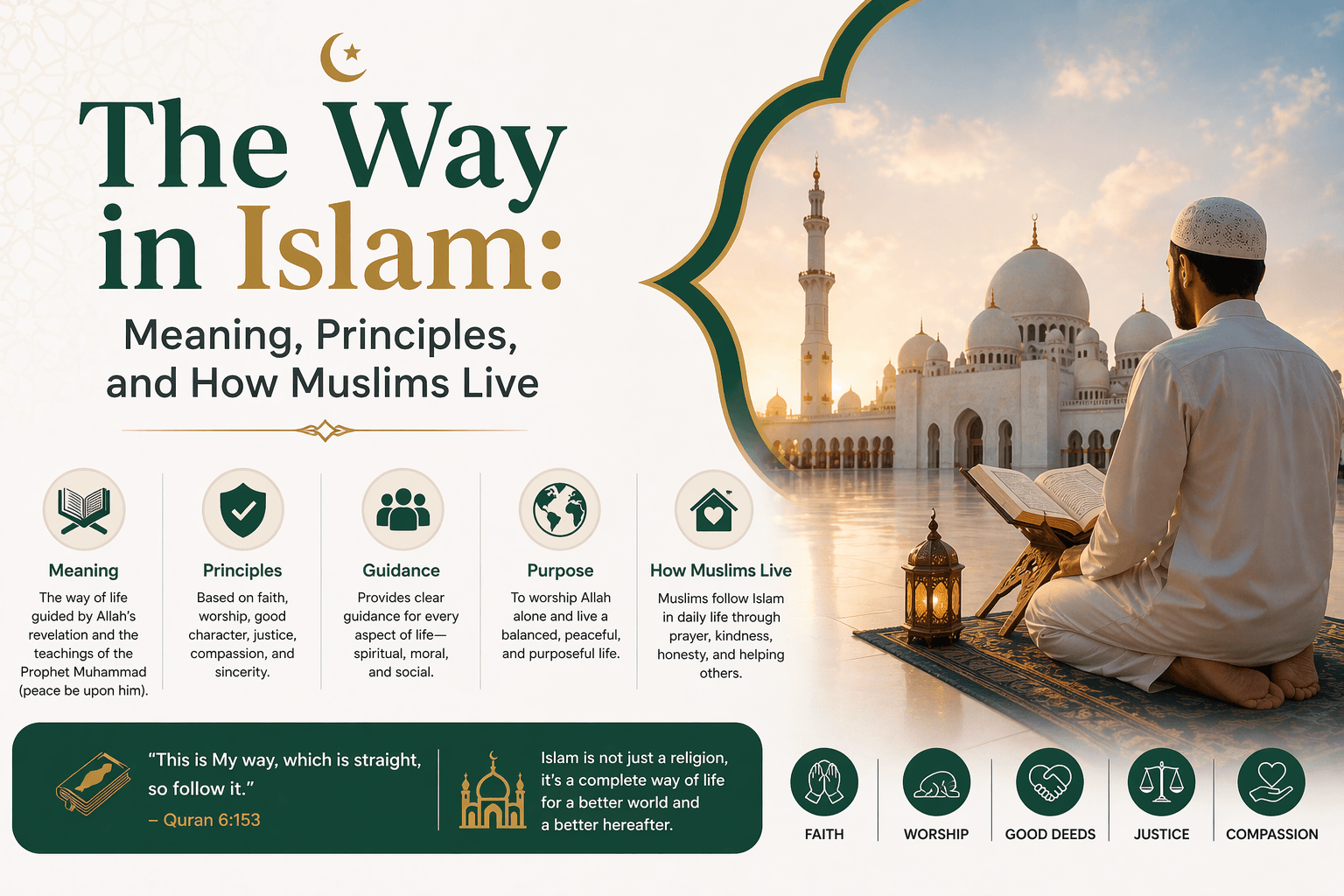
In Islam, “the way” refers primarily to Sirat al-Mustaqim the Straight Path a central concept mentioned in Surah Al-Fatiha, the opening chapter of the Quran, which Muslims recite in every prayer. More broadly, the way in Islam encompasses the complete guidance provided by the Quran and the Sunnah (the practices and teachings of Prophet Muhammad ﷺ), covering worship, ethics, social conduct, and daily life. It is not merely a set of rituals it is a comprehensive, God-conscious way of living that guides Muslims in every aspect of their existence, from how they pray to how they treat their neighbors.
For anyone seeking to understand Islam whether a curious non-Muslim, a new Muslim convert, or someone deepening their faith understanding “the way” is the starting point of it all.
What Does “The Way” Mean in Islam?
The Meaning of Sirat al-Mustaqim (The Straight Path)
The Arabic phrase Sirat al-Mustaqim (الصراط المستقيم) translates to “the Straight Path” or “the Right Way.” It appears in verse 1:6 of Surah Al-Fatiha, where Muslims ask God:
“Guide us to the Straight Path the path of those You have blessed, not of those who have earned anger, nor of those who have gone astray.”
Because Al-Fatiha is recited in every unit (rak’ah) of prayer, a practicing Muslim asks God for guidance to this path a minimum of 17 times every single day. This repetition reflects how central “the way” is in Islamic consciousness it is not a concept reserved for scholars but a living, daily reality for every believer.
Scholars explain that Sirat al-Mustaqim is the path of Iman (faith), Taqwa (God-consciousness), righteous deeds, and excellent character all working together as a unified way of life.
The Way as Guided by the Quran and Sunnah
Islam teaches that God did not leave humanity to figure out “the way” on their own. Two primary sources provide the complete roadmap:
The Quran the literal word of God revealed to Prophet Muhammad ﷺ over 23 years. The Quran describes itself as “a guidance for mankind” (Quran 2:185) and “a light and a clear Book” (Quran 5:15). Every major dimension of the Islamic way from belief in God, to justice, to family life is addressed within its 114 chapters.
The Sunnah the recorded sayings, actions, and approvals of Prophet Muhammad ﷺ, preserved in collections known as Hadith. The Quran itself (33:21) establishes why Muslims follow the Sunnah: “Indeed, in the Messenger of God you have an excellent example.” Together, the Quran and Sunnah form what Islamic scholars call the Deen the complete way of life.
The Five Pillars: The Foundation of the Islamic Way
The Islamic way of life is built on five foundational acts of worship known as the Five Pillars of Islam (Arkan al-Islam). These are not merely rituals they are the structural backbone of a Muslim’s relationship with God and with the wider human community.
Shahada (Declaration of Faith)
The first pillar is Shahada the sincere testimony that “There is no god but God (Allah), and Muhammad is His Messenger.” This declaration is the gateway into Islam and the lens through which every other pillar is understood. A life lived on the Straight Path begins with this acknowledgment of God’s oneness (Tawhid).
Salah, Zakat, Sawm, and Hajj
Salah (five daily prayers) connects the Muslim directly to God five times each day at dawn, midday, afternoon, sunset, and night. Each prayer involves physical prostration (sujood) and recitation of Quranic verses, maintaining a constant thread of divine remembrance throughout the day.
Zakat (obligatory charity) requires Muslims who possess wealth above a minimum threshold (nisab) to give 2.5% annually to those in need. It purifies wealth and reinforces that material possessions are a trust from God, not an end in themselves.
Sawm (fasting during Ramadan) involves abstaining from food, drink, and intimate relations from dawn to sunset for the entire lunar month of Ramadan. It cultivates self-discipline, empathy for the poor, and heightened spiritual awareness.
Hajj (pilgrimage to Mecca) is obligatory once in a lifetime for every Muslim who is physically and financially able. It is a profound act of unity millions of Muslims from every nationality stand together on the plains of Arafat, equalizing all distinctions of race, class, and nationality before God.
The Sunnah: Following the Way of Prophet Muhammad ﷺ
What Is the Sunnah?
The Sunnah literally means “the way” or “the trodden path.” In Islamic terminology, it refers to the entire body of Prophet Muhammad’s ﷺ practices how he prayed, ate, treated his family, conducted business, resolved conflicts, and worshipped God. The Sunnah gives life to the Quran’s commands by showing Muslims exactly how those commands were implemented by the Prophet himself.
Muslims follow the Sunnah not out of blind tradition but out of love for the Prophet ﷺ and obedience to God’s command in the Quran (4:80): “Whoever obeys the Messenger has obeyed God.”
Hadith as a Practical Guide to Daily Life
The Sunnah is preserved in Hadith collections meticulously verified records of the Prophet’s ﷺ words and actions, transmitted through chains of narrators (isnad). The most trusted collections include Sahih al-Bukhari and Sahih Muslim, both compiled in the 9th century CE and considered the most rigorously authenticated Hadith compilations in Islamic scholarship.
Through Hadith, Muslims learn the practical details of the Islamic way: how to perform wudu (ablution) before prayer, how to recite supplications (du’a), how to treat guests, how to conduct business fairly, and even how to greet fellow Muslims with “Assalamu Alaikum” “Peace be upon you.”
Islamic Ethics and Morality: The Inner Dimension of the Way
Akhlaq (Character and Conduct) in Islam
The Prophet Muhammad ﷺ said: “I was only sent to perfect good character.” This Hadith, recorded in collections by Imam Ahmad and al-Bayhaqi, reveals that the Islamic way is as much about inner character as it is about outer worship. Akhlaq Islamic ethics and moral character includes honesty, patience (sabr), humility (tawadu), gratitude (shukr), generosity, and compassion.
The Quran repeatedly pairs belief (iman) with righteous deeds (amal salih), making clear that faith without good character is incomplete. A Muslim who prays five times daily but lies, cheats, or mistreats others has not fully embodied the Islamic way.
Ihsan: Worship with Excellence and Awareness
The Prophet ﷺ described the three levels of Islam in a famous Hadith known as the Hadith of Jibreel (recorded in Sahih Muslim). The three levels are: Islam (submission through the Five Pillars), Iman (deeper faith in God, angels, scriptures, prophets, the Day of Judgment, and divine decree), and Ihsan the highest level.
Ihsan means “to worship God as though you see Him; for even if you do not see Him, He surely sees you.” It is the cultivation of constant divine awareness (muraqabah) acting with excellence, sincerity, and mindfulness in every act of worship and every human interaction. This inner dimension elevates the Islamic way from a checklist of rules into a living, spiritually conscious path.
The Islamic Way of Life in Daily Practice
Halal and Haram: Permitted and Forbidden
One of the most recognizable aspects of the Islamic way in daily life is the distinction between Halal (permitted) and Haram (forbidden). This framework covers food (no pork, no alcohol, meat must be slaughtered in God’s name), financial dealings (no interest/riba), entertainment, and personal conduct.
The Halal/Haram framework is not meant to restrict but to protect to preserve health, social harmony, spiritual purity, and human dignity. Islamic jurisprudence (Fiqh) provides detailed guidance on these rulings, derived from the Quran, Sunnah, scholarly consensus (Ijma), and analogical reasoning (Qiyas).
Family, Community, and Social Responsibilities
The Islamic way places enormous emphasis on family and community. The Quran (4:1) reminds believers of their shared origin and calls for maintaining family ties (silat al-rahim). Husbands and wives are described as “garments for one another” (Quran 2:187) sources of protection, warmth, and comfort.
Beyond family, the Islamic way calls Muslims to be active, contributing members of society. The Prophet ﷺ said: “The best of people are those most beneficial to people.” This translates into volunteering, giving charity, supporting neighbors, standing against injustice, and building institutions that serve the broader community.
How Muslims in the USA and Canada Practice the Islamic Way
There are an estimated 3.5 million Muslims in the United States and over 1.8 million in Canada, making Islam one of the fastest-growing religions in North America. Muslims in these countries practice the Islamic way within pluralistic, democratic societies attending mosques and Islamic centers, participating in interfaith dialogue, observing Ramadan, and contributing significantly to fields including medicine, law, education, and public service.
Organizations such as the Islamic Society of North America (ISNA) and countless local Muslim community centers actively support North American Muslims in living the Islamic way while navigating contemporary life. Many mosques offer classes for new Muslims and non-Muslims alike who wish to understand the path of Islam.
Sharia: Misunderstood Aspects of “The Way”
What Sharia Actually Means for Everyday Muslims
Few words in the Islamic lexicon are as misunderstood in Western media as Sharia. The Arabic word literally means “the path to the watering hole” a life-giving path, not a punitive code. Sharia is the divine law derived from the Quran and Sunnah, and for the vast majority of Muslims worldwide, it governs personal acts of worship, ethical conduct, family obligations, financial dealings, and charitable giving.
Islamic scholars note that the overwhelming majority of Sharia roughly 80–90% covers religious practices, ethics, and personal development rather than criminal law. For Muslims living in Western countries, Sharia manifests primarily in how they pray, fast, give charity, conduct business, and treat their families all entirely compatible with life in pluralistic democracies.
Frequently Asked Questions About the Way in Islam
What is “the way” in Islam?
In Islam, “the way” refers to Sirat al-Mustaqim the Straight Path which is the divinely guided path of worship, ethics, and conduct described in the Quran and exemplified by the Prophet’s Sunnah.
What is Sirat al-Mustaqim?
Sirat al-Mustaqim (الصراط المستقيم) means “the Straight Path.” It appears in Surah Al-Fatiha (1:6) and represents the path of righteousness, faith, and righteous deeds that Muslims seek to walk in every aspect of life.
What are the Five Pillars of Islam?
The Five Pillars are: (1) Shahada declaration of faith; (2) Salah five daily prayers; (3) Zakat obligatory charity; (4) Sawm fasting in Ramadan; and (5) Hajj pilgrimage to Mecca. They are the structural foundation of the Islamic way.
Conclusion: The Way in Islam Is a Path of Purpose and Peace
The way in Islam rooted in Sirat al-Mustaqim, embodied in the Sunnah, expressed through the Five Pillars, and refined through Ihsan and Akhlaq is far more than a religion in the conventional Western sense. It is a complete, integrated way of life that offers its followers a clear framework for worship, personal growth, family life, social responsibility, and spiritual fulfillment.
For more than 1.4 billion Muslims worldwide including millions across the United States and Canada the Islamic way provides daily guidance, deep meaning, and an unbroken connection to God that shapes every sunrise to sunset. Whether you are discovering Islam for the first time or deepening a lifelong commitment, the path is open, the guidance is clear, and the journey is one of purpose and peace.
Ready to walk the path? Explore the Quran the ultimate guide to the Islamic way of life directly at QuranLinkOnline.com. Read, listen, and reflect on God’s guidance, anytime and anywhere, completely free.