Introduction
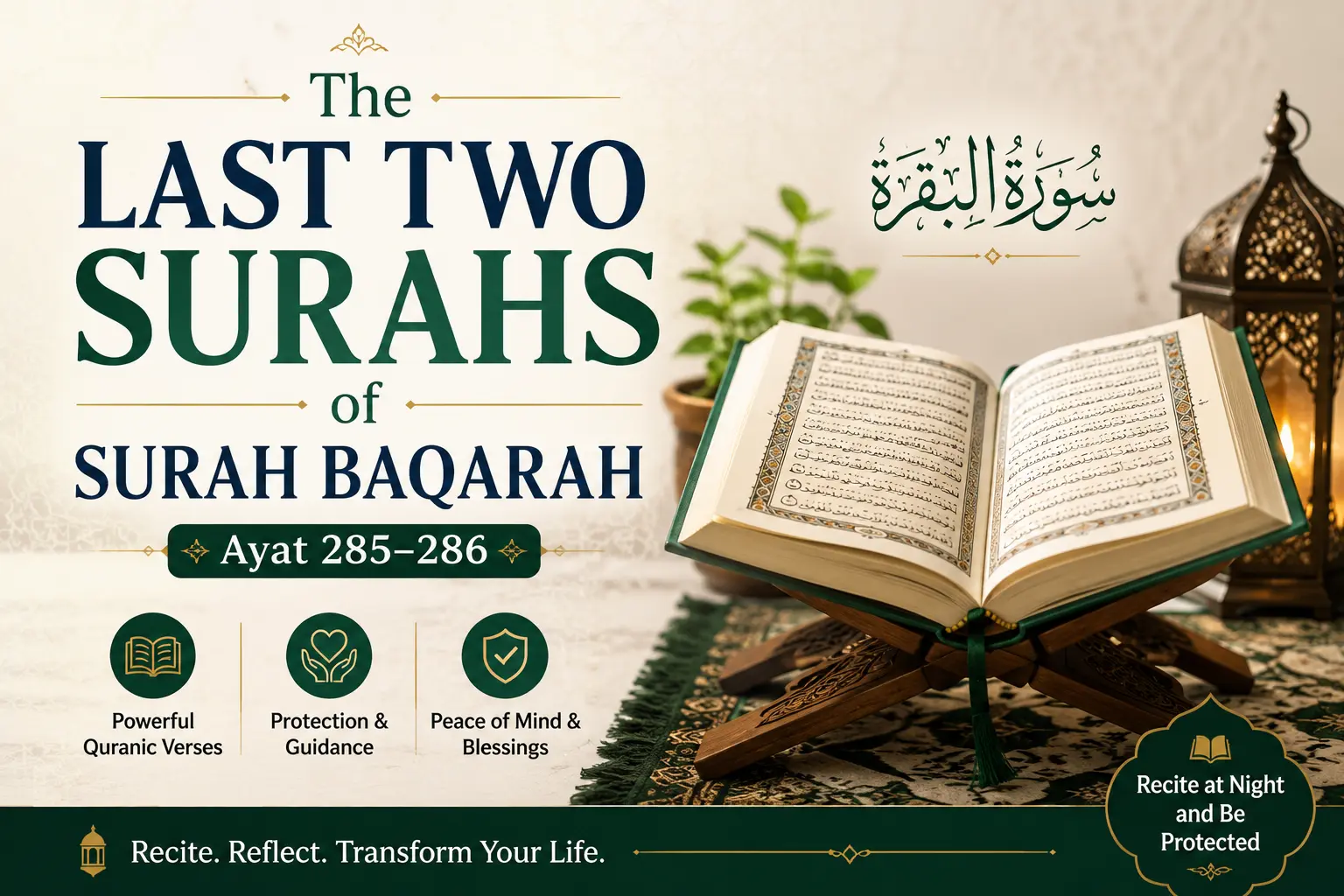
Many people search for the Last Two Surahs of Surah Baqarah hoping to learn about a set of verses known for protection, comfort, and spiritual strength. If you’ve heard a friend, parent, or imam mention these verses and wondered what they mean and why they matter, you’re in the right place. This guide explains everything in simple, accurate terms so you can start reciting them with understanding tonight.
Quick Answer Box
Quick Answer: The phrase “Last Two Surahs of Surah Baqarah” is commonly used, but it actually refers to the last two Ayahs (verses) of Surah Al-Baqarah — Ayahs 285 and 286, not two separate surahs. These verses summarize faith, mercy, and reliance on Allah, and an authentic hadith states that reciting them at night is sufficient protection for a believer.
What Are the Last Two Surahs of Surah Baqarah?
Surah Al-Baqarah is the longest chapter in the Quran, with 286 ayahs. The final two verses, 285 and 286, are widely recited because of their powerful meaning and the authentic hadith connected to them.
These verses are not a separate surah. They are the closing section of Surah Al-Baqarah itself, and this is where the confusion usually starts.
Correcting a Common Misunderstanding
Many searchers type “Last Two Surahs of Surah Baqarah” when they really mean the Last Two Ayahs of Surah Al-Baqarah (285–286). This is a simple language mix-up, not a religious difference. There are not two separate surahs at the end of Al-Baqarah. Instead, there are two connected ayahs that scholars and hadith scholars treat as one unit because of how the Prophet ﷺ described their virtue.
It’s also worth clarifying that these two ayahs are different from Ayatul Kursi, which is Ayah 255 of the same surah. Ayatul Kursi is another well-known protective verse, but it is separate from Ayahs 285–286. Many Muslims recite both, but they are not the same verses.
Arabic Text
Ayah 285: آمَنَ الرَّسُولُ بِمَا أُنزِلَ إِلَيْهِ مِن رَّبِّهِ وَالْمُؤْمِنُونَ ۚ كُلٌّ آمَنَ بِاللَّهِ وَمَلَائِكَتِهِ وَكُتُبِهِ وَرُسُلِهِ لَا نُفَرِّقُ بَيْنَ أَحَدٍ مِّن رُّسُلِهِ ۚ وَقَالُوا سَمِعْنَا وَأَطَعْنَا ۖ غُفْرَانَكَ رَبَّنَا وَإِلَيْكَ الْمَصِيرُ
Ayah 286: لَا يُكَلِّفُ اللَّهُ نَفْسًا إِلَّا وُسْعَهَا ۚ لَهَا مَا كَسَبَتْ وَعَلَيْهَا مَا اكْتَسَبَتْ ۗ رَبَّنَا لَا تُؤَاخِذْنَا إِن نَّسِينَا أَوْ أَخْطَأْنَا ۚ رَبَّنَا وَلَا تَحْمِلْ عَلَيْنَا إِصْرًا كَمَا حَمَلْتَهُ عَلَى الَّذِينَ مِن قَبْلِنَا ۚ رَبَّنَا وَلَا تُحَمِّلْنَا مَا لَا طَاقَةَ لَنَا بِهِ ۖ وَاعْفُ عَنَّا وَاغْفِرْ لَنَا وَارْحَمْنَا ۚ أَنتَ مَوْلَانَا فَانصُرْنَا عَلَى الْقَوْمِ الْكَافِرِينَ
English Translation
285: The Messenger believes in what has been revealed to him from his Lord, and so do the believers. Each one believes in Allah, His angels, His books, and His messengers. They say, “We make no distinction between any of His messengers.” And they say, “We hear and we obey. Grant us Your forgiveness, our Lord, and to You is the final return.”
286: Allah does not burden a soul beyond what it can bear. It will have the good it has earned, and it will bear the consequences of the evil it has earned. Our Lord, do not hold us responsible if we forget or make a mistake. Our Lord, do not place upon us a burden like the one You placed on those before us. Our Lord, do not burden us with what we cannot bear. Pardon us, forgive us, and have mercy on us. You are our Protector, so help us against the disbelieving people.
Transliteration
285: Aamanar-Rasoolu bimaa unzila ilayhi mir Rabbihee wal mu’minoon, kullun aamana billaahi wa malaa’ikatihee wa kutubihee wa rusulihee laa nufarriqu bayna ahadim mir rusulih, wa qaaloo sami’naa wa ata’naa ghufraanaka Rabbanaa wa ilaykal maseer.
286: Laa yukalliful laahu nafsan illaa wus’ahaa, lahaa maa kasabat wa ‘alayhaa mak tasabat, Rabbanaa laa tu’aakhiznaa in naseenaa aw akhta’naa, Rabbanaa wa laa tahmil ‘alaynaa isran kamaa hamaltahoo ‘alal lazeena min qablinaa, Rabbanaa wa laa tuhammilnaa maa laa taaqata lanaa bih, wa’fu ‘annaa waghfir lanaa warhamnaa, Anta mawlaanaa fansurnaa ‘alal qawmil kaafireen.
Meaning Explained
These two ayahs bring Surah Al-Baqarah to a close with a summary of faith and a heartfelt prayer. Ayah 285 confirms belief in Allah, His angels, His books, and all His messengers without discrimination. Ayah 286 reminds every believer that Allah never asks more of a person than they can handle, then moves into a sincere dua asking for forgiveness, ease, and mercy.
Together, they connect belief with reliance on Allah, making them a complete spiritual statement in just two verses.
Benefits Mentioned in Authentic Hadith
The virtue of these verses comes directly from authentic hadith, not from opinion or folklore.
- Prophet Muhammad ﷺ said that whoever recites the last two ayahs of Surah Al-Baqarah at night, they will be sufficient for him. This hadith is recorded in Sahih al-Bukhari and Sahih Muslim.
- Another hadith in Sahih Muslim describes how these verses were given to the Prophet ﷺ directly during the night of Isra and Mi’raj, showing their special status.
Scholars explain “sufficient for him” to mean protection and spiritual coverage for the night, though they caution against adding meanings beyond what the hadith actually states. This is why authentic sourcing matters, and it’s a habit every Muslim should build when learning duas and Quranic virtues.
Why Muslims Recite Them Every Night
This is one of the most consistent Sunnah practices among Muslims worldwide. Reciting these ayahs before sleep is:
- Easy to memorize, even for beginners
- Backed by authentic hadith, not weak narrations
- A short but complete act of worship before rest
- Part of a broader habit of Evening Adhkar that many families teach their children
Because the practice is simple and the reward is significant, it has remained part of daily Muslim life for over 1,400 years.
When Should You Recite Them?
The hadith specifically mentions reciting these ayahs at night, ideally before sleeping. Many Muslims include them as part of their Morning Adhkar and Evening Adhkar routine, alongside other short surahs and duas. There’s no restriction on reciting them at other times too, since the Quran can be read at any hour, but the specific virtue mentioned in hadith applies to nighttime recitation.
Can They Be Used for Protection?
Muslims often recite Ayahs 285–286 alongside other well-known protective verses like Ayatul Kursi and the final two surahs of the Quran (Al-Falaq and An-Nas) as part of a nightly protection routine. The Quran itself is described as a source of guidance, healing, and mercy for believers. Based on the authentic hadith mentioned earlier, these two ayahs specifically offer sufficiency and protection for the person who recites them before sleeping.
It’s important to recite with sincerity and understanding rather than treating the verses like a formula. Real benefit comes from daily Quran recitation, reflection, and consistency, not simply repeating words.
Lessons We Learn
- Faith means believing in all of Allah’s messengers, not picking and choosing.
- Allah’s mercy means no one is burdened beyond their ability.
- Dua should be sincere, humble, and directed to Allah alone.
- Small, consistent acts of worship, like nightly recitation, carry major spiritual reward.
How to Memorize Them Easily
- Listen to a qualified reciter say each ayah slowly.
- Repeat one phrase at a time instead of the whole ayah at once.
- Read the translation so the meaning sticks alongside the Arabic.
- Practice after every prayer for a week.
- Recite them nightly until they become automatic.
Memorization becomes far easier and more accurate when guided by a certified teacher who can correct pronunciation as you go, rather than learning alone from videos.
Why Every Muslim Family Should Teach These Verses
These ayahs are short, meaningful, and rooted in authentic hadith, which makes them one of the first things families teach their children after the basic surahs. Teaching kids these verses early builds a lifelong habit of nightly remembrance and helps them understand the meaning behind their prayers, not just the recitation.
This is exactly the kind of foundational learning covered in structured Quran for Kids programs, where children learn correct pronunciation, meaning, and application together instead of memorizing without understanding.
How Learning Quran with a Qualified Teacher Helps
Reading Arabic script correctly takes more than watching videos. A certified Quran teacher helps with:
- Correct Tajweed rules so pronunciation matches the Prophet’s ﷺ own recitation style
- Understanding word-by-word meaning, not just translation
- Personalized correction that self-study cannot offer
- Building consistency through structured, one-on-one sessions
Whether you’re an adult starting your Quran journey or a parent looking for a Quran teacher for your children, working with a qualified instructor makes recitation more accurate, meaningful, and confident. This is where structured Online Quran Classes make a real difference for families across the USA.
Conclusion
The Last Two Surahs of Surah Baqarah — more accurately known as the last two ayahs of Surah Al-Baqarah — carry deep meaning and authentic virtue. They summarize belief, mercy, and sincere dua in just a few lines, and reciting them nightly is a Sunnah rooted in Sahih al-Bukhari and Sahih Muslim. Learning to recite them correctly, along with the rest of the Quran, is easier and more rewarding with guidance from a qualified teacher.
If you want to recite these verses, and the entire Quran, with correct Tajweed and real understanding, QuranLinkOnline offers certified teachers, flexible USA time zone classes, and one-on-one lessons for kids and adults alike.
Frequently Asked Questions
1. Are the “Last Two Surahs of Surah Baqarah” actually two separate surahs? No. This phrase is a common search term, but it refers to the last two ayahs (285 and 286) of Surah Al-Baqarah, not two separate chapters of the Quran.
2. What is the hadith about reciting these verses at night? Prophet Muhammad ﷺ said that whoever recites the last two ayahs of Surah Al-Baqarah at night, they will be sufficient for him. This is recorded in both Sahih al-Bukhari and Sahih Muslim.
3. Is Ayatul Kursi the same as the last two ayahs of Baqarah? No. Ayatul Kursi is Ayah 255 of Surah Al-Baqarah, while the last two ayahs are 285 and 286. They are different verses, though many Muslims recite both during nightly adhkar.
4. Can beginners memorize these verses easily? Yes. Both ayahs are commonly taught to beginners and children because of their length and clear meaning. Learning with a qualified teacher speeds up correct memorization and pronunciation.
5. Where can I learn to recite these verses correctly? You can learn proper Tajweed and pronunciation through certified, one-on-one Online Quran Classes with QuranLinkOnline, designed for both kids and adults in the USA.
Ready to Recite with Confidence?
Understanding these verses is only the first step. Reciting them correctly, with proper Tajweed and real understanding, is where lasting benefit comes from. QuranLinkOnline offers certified Quran teachers, flexible scheduling in USA time zones, and one-on-one classes for kids and adults, including Nazra, Hifz, and Tajweed programs. Book your free trial class today and start learning the Quran with confidence, one verse at a time.