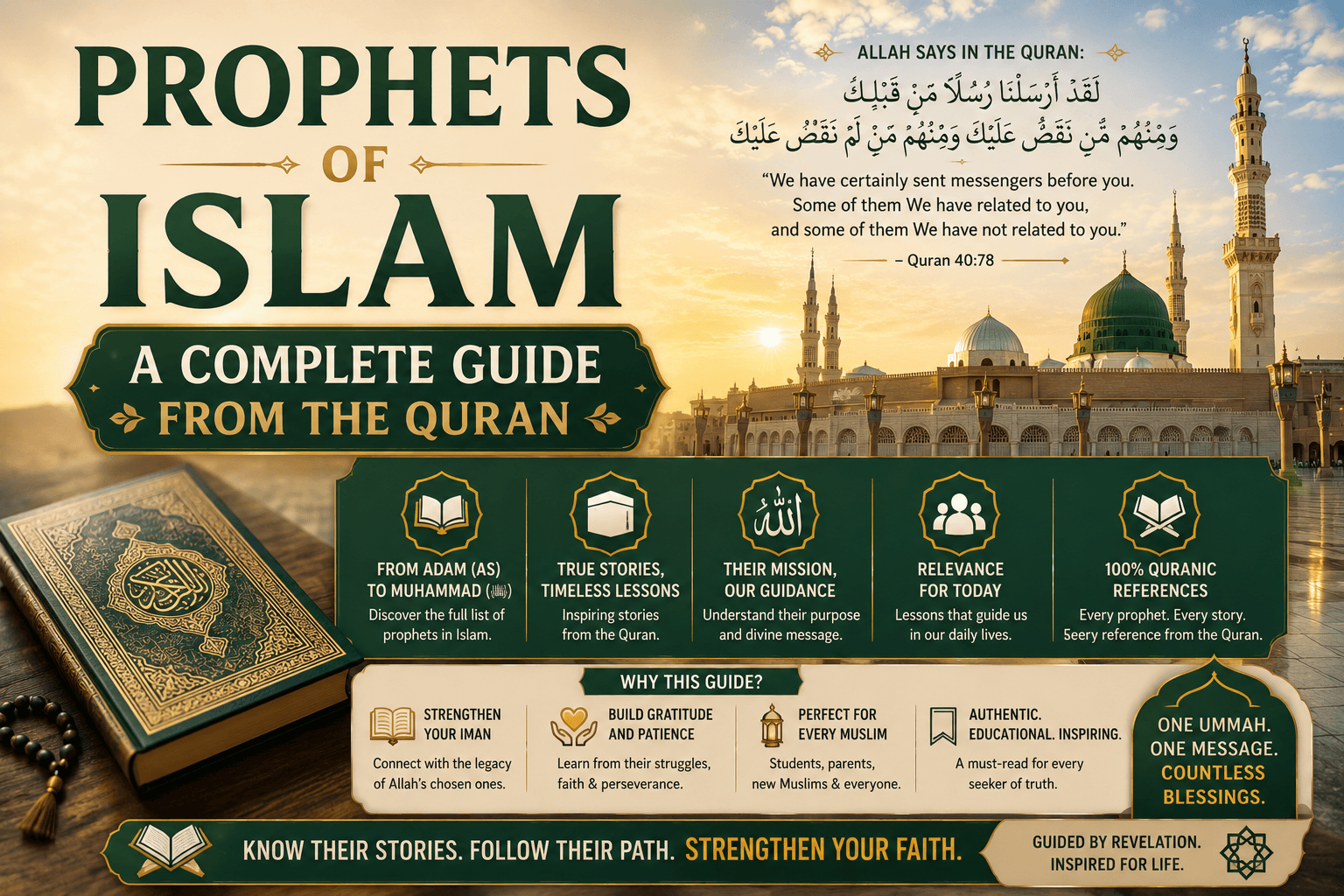
If you have ever read the Quran or studied Islamic history, you have already met some of the most remarkable human beings who ever lived. The Prophets of Islam are central to Islamic belief — men chosen by Allah to carry His guidance to humanity, in every age and every corner of the earth.
For Muslims in the USA, for new reverts finding their footing, and for parents raising children with Islamic values, understanding who these prophets were and what they stood for is not just an academic exercise. It is the foundation of faith.
This guide covers everything you need to know about the Prophets of Islam — from their number and names to their shared qualities and the timeless lessons they left behind.
Who Are the Prophets of Islam?
In Islam, a prophet (Nabi) is a human being chosen by Allah to receive divine revelation and deliver guidance to their people. A messenger (Rasool) is a prophet who also received a new scripture or law.
Muslims believe that Allah sent prophets to every nation throughout human history — not just to the Arab world, but to every civilization and people. This is stated clearly in the Quran:
“And for every nation there is a messenger.” — Surah Yunus (10:47)
Every prophet carried the same core message: Tawheed — the oneness of Allah — and the call to live a moral, accountable, and spiritually conscious life.
✅ Quick Definition
Prophets of Islam are divinely appointed human beings chosen by Allah to guide people toward monotheism, moral conduct, and preparation for the Hereafter. They did not create the message — they delivered it. The first prophet was Prophet Adam (AS) and the last and final prophet was Prophet Muhammad (PBUH).
Why Did Allah Send Prophets?
Human beings need guidance — not just laws and rules, but a living example of how to follow them. This is one of the deepest wisdoms behind prophethood.
Allah sent prophets for several reasons:
- To deliver the message of Tawheed — that Allah alone deserves worship
- To clarify right from wrong in a way humans could practically follow
- To establish justice in societies and communities
- To warn people about accountability on the Day of Judgment
- To give glad tidings of Allah’s mercy and reward for righteousness
- To serve as human role models — not angels, not myths, but real people who struggled and succeeded
The Quran states:
“Messengers as bringers of good tidings and warners, so that mankind would have no argument against Allah after the messengers.” — Surah An-Nisa (4:165)
How Many Prophets Are Mentioned in the Quran?
The Quran mentions 25 prophets and messengers by name. Islamic tradition holds that the total number of prophets sent throughout human history is far greater — with narrations suggesting figures between 124,000 and 315,000 — though these specific numbers are not found in the Quran itself and should be understood as part of broader scholarly discussion.
What matters most is this: the Quran names 25, and Muslims are required to believe in all of them.
The 25 Prophets Mentioned in the Quran
| # | Prophet Name | English Equivalent |
|---|---|---|
| 1 | Adam (AS) | Adam |
| 2 | Idris (AS) | Enoch |
| 3 | Nuh (AS) | Noah |
| 4 | Hud (AS) | Hud |
| 5 | Salih (AS) | Saleh |
| 6 | Ibrahim (AS) | Abraham |
| 7 | Lut (AS) | Lot |
| 8 | Ismail (AS) | Ishmael |
| 9 | Ishaq (AS) | Isaac |
| 10 | Yaqub (AS) | Jacob |
| 11 | Yusuf (AS) | Joseph |
| 12 | Shuayb (AS) | Jethro |
| 13 | Ayyub (AS) | Job |
| 14 | Musa (AS) | Moses |
| 15 | Harun (AS) | Aaron |
| 16 | Dhul-Kifl (AS) | Ezekiel |
| 17 | Dawud (AS) | David |
| 18 | Sulayman (AS) | Solomon |
| 19 | Ilyas (AS) | Elijah |
| 20 | Al-Yasa (AS) | Elisha |
| 21 | Yunus (AS) | Jonah |
| 22 | Zakariyya (AS) | Zechariah |
| 23 | Yahya (AS) | John |
| 24 | Isa (AS) | Jesus |
| 25 | Muhammad (PBUH) | Muhammad |
Common Qualities of the Prophets of Islam
Every prophet was unique in his people, his time, and his mission. Yet they all shared four fundamental qualities that Islamic scholarship has identified as inseparable from prophethood:
1. Siddiq (Truthfulness) Every prophet was absolutely truthful. They never deceived the people they were sent to guide — even when the truth was unwelcome and dangerous.
2. Amanah (Trustworthiness) Prophets were the most trustworthy members of their communities. The Prophet Muhammad (PBUH) was known as Al-Amin — “The Trustworthy” — long before he received revelation.
3. Tabligh (Conveying the Message) Every prophet delivered the message of Allah completely and without hiding any part of it, regardless of opposition, ridicule, or persecution.
4. Fatanah (Intelligence) Prophets were people of wisdom and sharp understanding — capable of debating, reasoning, and guiding their communities with clarity and sound judgment.
Why Muslims Respect All Prophets Equally
One of the most distinctive features of Islamic belief is that Muslims are required to respect and believe in all prophets — not just Prophet Muhammad (PBUH), but also Prophet Isa (Jesus, AS), Prophet Musa (Moses, AS), Prophet Ibrahim (Abraham, AS), and every other prophet mentioned in the Quran.
The Quran is explicit about this:
“We make no distinction between any of His messengers.” — Surah Al-Baqarah (2:285)
This is not a matter of cultural preference. It is a pillar of Islamic faith. A Muslim who rejects or disrespects any prophet has deviated from the core of Islamic belief.
Lessons from the Stories of the Prophets
The Quran does not tell the stories of prophets simply as historical accounts. Every story is embedded with guidance — specifically for the reader, in their current situation.
From Prophet Nuh (AS): The importance of steadfast patience. He called his people to Allah for 950 years without giving up. That level of commitment teaches Muslims what true perseverance in faith looks like.
From Prophet Ibrahim (AS): Absolute trust in Allah (Tawakkul). When thrown into fire for refusing to worship idols, he placed complete trust in Allah — and Allah made the fire cool for him. His life teaches that no sacrifice made for Allah’s sake is ever wasted.
From Prophet Yusuf (AS): Dignity under oppression. Betrayed by his brothers, sold into slavery, and imprisoned unjustly — yet he never lost his character, his patience, or his connection to Allah. His story, told entirely in a single Surah, remains one of the most powerful narratives in human literature.
From Prophet Musa (AS): Courage to speak truth to power. Standing before Pharaoh — the most powerful ruler of his time — with nothing but a staff and divine permission, Prophet Musa (AS) showed that truth does not require worldly power to prevail.
From Prophet Muhammad (PBUH): The complete human example. As the final prophet, his life — documented in extraordinary detail through the Seerah and Hadith — serves as the practical manual for living as a Muslim in every dimension of life.
Why Learning About the Prophets Matters Today
The stories and teachings of the prophets are not museum pieces. They are living guidance.
A teenager dealing with peer pressure can find strength in Prophet Yusuf (AS), who maintained his character under conditions far more extreme than social media. A parent struggling to raise children with faith can look to Prophet Ibrahim (AS), who raised a family of prophets in a world hostile to monotheism. A professional navigating workplace ethics can draw from Prophet Dawud (AS) — a king, warrior, and devotee of Allah who balanced immense responsibility with constant remembrance of God.
Understanding the prophets gives Muslims — and anyone exploring Islam — a richer, more grounded understanding of what the Quran is teaching and why.
How Quran Link Online Helps You Learn More About Islam
Understanding the Prophets of Islam begins with the Quran — and reading the Quran begins with the right teacher.
At Quran Link Online, our certified teachers guide students through the Quran from the very basics to advanced study, with programs designed for every age and background:
- Online Quran Classes — Live, one-on-one sessions with qualified teachers across all US time zones
- Quran Classes for Kids — Age-appropriate programs starting with Noorani Qaida for young learners
- Quran Classes for Adults — Structured beginner-to-advanced learning for adult students, including reverts
- Islamic Studies Course — Covering Seerah (Prophet’s biography), Tafseer, Aqeedah, and the stories of the prophets
- Tajweed Course — Learn to recite the Quran the way it was revealed, with correct pronunciation
- Hifz Program — For students who want to memorize the Quran with a structured revision system
- Female Quran Teachers — Qualified female instructors available for sisters and young girls
Frequently Asked Questions
Q1: Who are the Prophets of Islam? The Prophets of Islam are men chosen by Allah to deliver His guidance to humanity, with the Quran naming 25 of them from Prophet Adam (AS) to Prophet Muhammad (PBUH).
Q2: How many prophets are mentioned in the Quran? The Quran mentions exactly 25 prophets and messengers by name, all of whom Muslims are required to believe in and respect.
Q3: Who was the first prophet in Islam? Prophet Adam (AS) is recognized as the first human being and the first prophet in Islam, sent with guidance for himself and his descendants.
Q4: Who was the last prophet in Islam? Prophet Muhammad (PBUH) is the final and last prophet in Islam, after whom no new prophet will come until the Day of Judgment.
Q5: Do Muslims believe in Prophet Jesus (Isa AS)? Yes — Muslims believe in and deeply respect Prophet Isa (Jesus AS) as one of the greatest messengers of Allah, though they believe he was a prophet, not divine.
Conclusion
The Prophets of Islam represent Allah’s mercy toward humanity across every age and civilization. From Prophet Adam (AS) — the first human — to Prophet Muhammad (PBUH) — the final messenger — every prophet carried the same light: the oneness of Allah, the call to righteousness, and the promise of accountability and reward.
Learning about these prophets is not just enriching — it deepens a Muslim’s faith, connects them to the Quran, and provides guidance for navigating the real challenges of life in the modern world.
The best way to connect with these stories is through the Quran itself — read with understanding, recited with proper Tajweed, and studied with a qualified teacher who can bring the meaning to life.
🎯 Start Your Quran and Islamic Learning Journey Today
Whether you are a parent wanting to build your child’s Islamic foundation, a revert eager to understand the Quran, or an adult ready to explore Islamic studies seriously — Quran Link Online is here to guide you every step of the way.
Book your free trial class today — certified teachers, flexible schedules, one-on-one sessions, and programs for every age and level.
Give yourself and your family the gift of genuine Quranic knowledge — rooted in the same tradition that the Prophets of Islam carried across generations.
Quran Link Online — Certified Online Quran Classes | Islamic Studies | Tajweed | Hifz | Kids & Adults Programs