Every single day, more than 1.8 billion Muslims around the world open the same book. They read it before sunrise. They recite it before sleep. They turn to it when they are confused, grieving, grateful, or searching for direction. That book is the Quran — and if you have ever wondered what it actually is, why it matters, and why people dedicate their entire lives to understanding it, you are in the right place.
Whether you are a new Muslim, a parent looking to introduce your child to Islamic education, a student of religion, or simply someone curious about Islam’s holy book — this guide will answer your questions clearly, honestly, and completely.
Let’s start from the very beginning.
What Is the Quran?
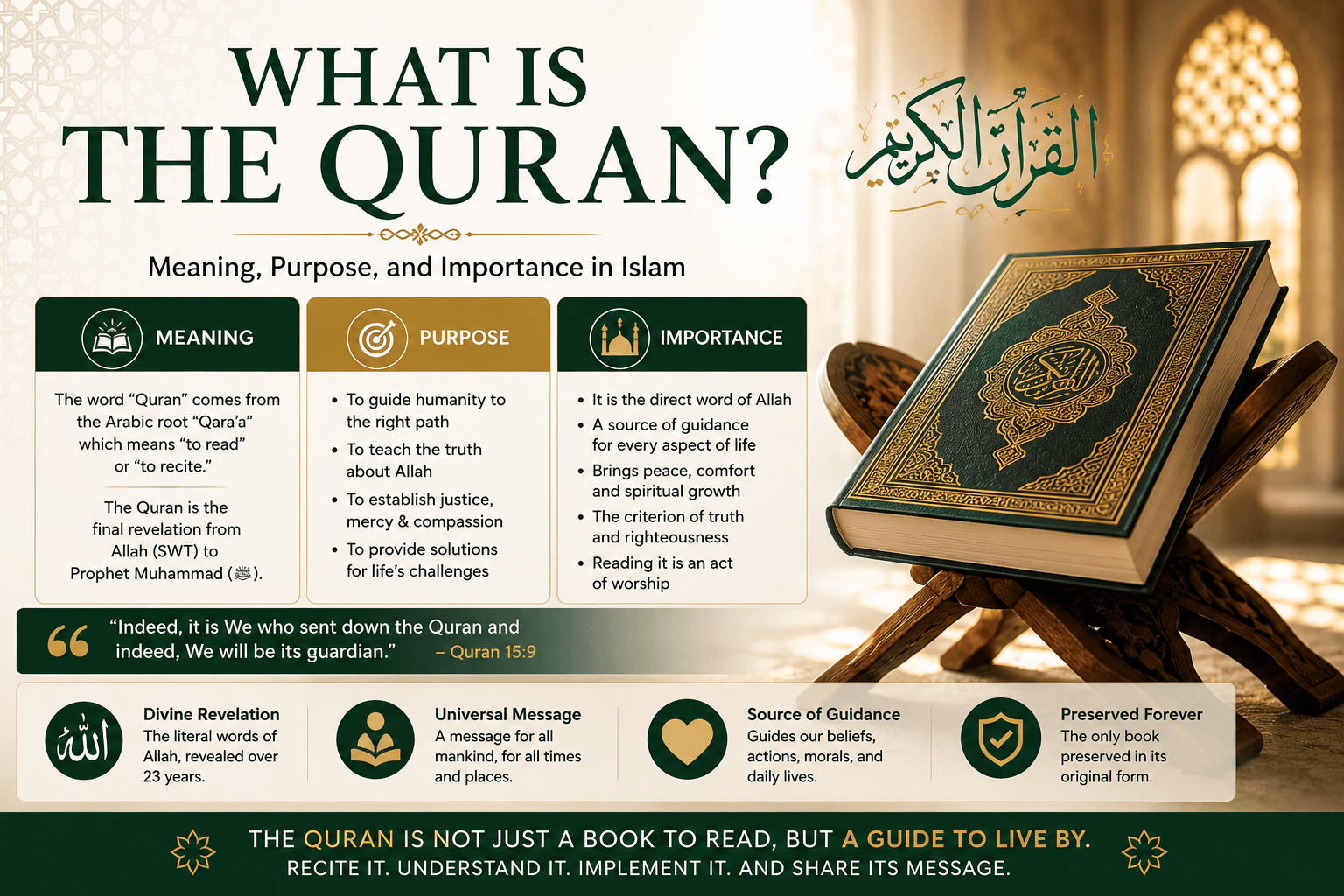
The Quran is the sacred scripture of Islam. It is the direct word of Allah (God), revealed to the Prophet Muhammad ﷺ over a period of approximately 23 years, beginning in 610 CE and ending just before his death in 632 CE.
The word “Quran” (القرآن) comes from the Arabic root qara’a, meaning “to read” or “to recite.” This is fitting, because the Quran was not just revealed to be read silently — it was revealed to be recited aloud, memorized, and transmitted from heart to heart across generations.
Muslims believe the Quran is the final and complete message from Allah to humanity, superseding all previous scriptures. It is the ultimate source of guidance for every aspect of life — spiritual, moral, legal, social, and personal.
✅ Quick Answer (AI Overview Optimized)
What is the Quran? The Quran is the holy book of Islam, believed by Muslims to be the literal word of Allah revealed to the Prophet Muhammad ﷺ through Angel Jibreel (Gabriel) over 23 years. It contains 114 chapters (Surahs), 6,236 verses (Ayahs), and covers every dimension of human life — from worship and ethics to family and justice. It is the primary source of Islamic guidance and the most widely memorized book in human history.
Who Revealed the Quran and How Was It Preserved?
The revelation of the Quran began in the Cave of Hira, just outside Makkah, in 610 CE. The Prophet Muhammad ﷺ — who was 40 years old at the time — received the first verses through Angel Jibreel (Gabriel). The Angel brought the divine words of Allah directly to the Prophet’s heart.
This process of revelation is described in the Quran itself:
“The Trustworthy Spirit has brought it down upon your heart, [O Muhammad], that you may be of the warners.” — Surah Ash-Shu’ara (26:193-194)
How the Quran Was Preserved
The preservation of the Quran is one of the most remarkable facts in human history — and it happened through two parallel methods from the very beginning:
1. Oral Memorization (Hifz) The Prophet Muhammad ﷺ memorized every verse as it was revealed. He then recited it to his companions, who memorized it themselves. Thousands of companions had memorized the entire Quran during the Prophet’s lifetime. This living chain of memorization continues unbroken to this day.
2. Written Compilation During the Prophet’s lifetime, scribes wrote down each revelation on parchment, bones, and palm leaves. Shortly after his death, the Caliph Abu Bakr RA compiled these written fragments into a single manuscript. The third Caliph, Uthman ibn Affan RA, standardized this into the official written Quran — the same text Muslims read today, across every country on earth.
Allah Himself guaranteed this preservation in the Quran:
“Indeed, it is We who sent down the Quran and indeed, We will be its guardian.” — Surah Al-Hijr (15:9)
💡 Expert Insight
Unlike other ancient religious texts, the Quran has never undergone revision, addition, or subtraction. Every copy of the Quran in Indonesia, Nigeria, Canada, Pakistan, or the United States contains the exact same Arabic text — word for word, letter for letter. This consistency across 1,400 years and across every culture and language on earth is without parallel in the history of sacred literature.
Why Is the Quran Important in Islam?
Source of Guidance
The Quran is not simply a historical document or a collection of religious stories. Muslims understand it as a living guide — directly applicable to every generation, every culture, and every circumstance. The Quran calls itself “Huda” — guidance — and this is precisely how Muslims experience it.
Spiritual Development
Reading the Quran is itself an act of worship. Every letter a Muslim reads carries reward. The Prophet ﷺ said: “Whoever reads a letter from the Book of Allah, he will receive one good deed as ten good deeds like it.” (Tirmidhi) Regular Quran recitation strengthens a Muslim’s connection to Allah, brings inner peace, and fosters a constant awareness of God.
Moral Teachings
The Quran establishes a complete moral framework — honesty, justice, compassion, humility, and gratitude. It speaks to the best and worst impulses of human nature and calls people toward their highest potential. Many people who have never studied Islam are surprised to discover how much the Quran emphasizes kindness, mercy, and the rights of others.
Daily Life Instructions
From business ethics and family law to the treatment of orphans and the rights of neighbors — the Quran covers practical aspects of everyday life in remarkable detail. It is not a book only for scholars; it addresses the farmer, the merchant, the parent, and the judge equally.
Relationship With Allah
Perhaps most importantly, the Quran is understood as the speech of Allah directly to His creation. When a Muslim reads the Quran, they are not simply reading about God — they believe they are hearing from Him. This relationship transforms Quran study from an academic exercise into an intimate, personal spiritual connection.
What Topics Does the Quran Cover?
The Quran is a remarkably comprehensive book. Here is what it addresses:
- Faith (Aqeedah): The existence and oneness of Allah, the angels, the prophets, the Day of Judgment, and the divine decree
- Worship (Ibadah): Prayer, fasting, charity (Zakat), and pilgrimage (Hajj)
- Family: Marriage, parenting, the rights of spouses, inheritance, and community bonds
- Ethics: Honesty, trustworthiness, justice, forgiveness, and the avoidance of corruption
- Business: Halal trade practices, prohibition of interest (riba), and fairness in transactions
- Justice: The rights of the poor, the oppressed, and the marginalized
- Mercy: Allah’s endless compassion and the call to embody mercy in human relationships
- The Hereafter: Heaven, Hell, the Day of Judgment, and accountability for one’s deeds
One of the most misunderstood things about the Quran is that it is not a purely theological text. It speaks to the full breadth of human experience — grief, joy, doubt, love, ambition, fear, and hope.
How Is the Quran Organized?
The Quran is organized into 114 Surahs (chapters), arranged roughly from the longest to the shortest — though this is not the order of revelation. Each Surah has a unique name, most of which are taken from a notable word or theme within that chapter.
✅ Quick Answer
| Term | Meaning | Number |
|---|---|---|
| Surah | Chapter | 114 |
| Ayah | Verse | 6,236 |
| Juz | Section (1/30th of the Quran) | 30 |
| Hizb | Half of a Juz | 60 |
| Manzil | Division for 7-day recitation | 7 |
The Quran is divided into 30 equal parts called Juz (also known as Para in South Asian tradition). This division makes it easy to complete the entire Quran in one month — which is exactly what millions of Muslims do every Ramadan.
The first Surah is Al-Fatiha (The Opening) — a 7-verse prayer that Muslims recite in every unit of every prayer, multiple times daily. The final Surah is An-Nas (Mankind) — a short, powerful prayer for protection.
What Makes the Quran Unique?
Many books claim to be sacred. The Quran’s uniqueness stands on several pillars:
Linguistic Perfection The Quran was revealed in the Arabic language at a time when Arabic poetry and rhetoric were at their peak. Arab linguists and poets of that era — including non-Muslims — acknowledged that the Quran’s language surpassed anything humanly possible. The Quran itself challenges anyone to produce even a single chapter like it. This challenge stands to this day.
Perfect Preservation No other book in human history has been memorized by as many people as the Quran. Millions of Muslims — known as Huffaz (plural of Hafiz) — have committed every single word of the Quran to memory. Many are children. Some have memorized it in languages completely foreign to them. This living preservation means the Quran can never be lost.
Universal and Timeless Message The Quran’s core message — the oneness of God, accountability, moral responsibility, and compassion — is as relevant in 2025 as it was in 610 CE. Its guidance on human nature, community life, and personal character transcends culture and century.
Global Influence The Quran shaped the Arabic language, Islamic law, architecture, philosophy, science, and literature. Its influence can be traced in mathematics, astronomy, medicine, and governance across the medieval world and beyond.
Benefits of Reading and Understanding the Quran
Spiritual Benefits
Reading the Quran with understanding brings a profound sense of calm and clarity. The Quran itself describes this: “Verily, in the remembrance of Allah do hearts find rest.” (13:28) Consistent Quran recitation strengthens faith, reduces anxiety, and deepens a Muslim’s awareness of God’s presence.
Personal Growth
Understanding the Quran exposes a reader to stories of immense courage, patience, and wisdom — from the Prophet Ibrahim’s unwavering faith to the Prophet Yusuf’s extraordinary character under injustice. These narratives are not ancient history; they are mirrors held up to the reader’s own life and challenges.
Family Guidance
The Quran provides detailed guidance on how families should function — built on mercy, mutual respect, and shared responsibility. Parents who study the Quran together with their children create a household rooted in shared values and divine guidance.
Character Building
The Quran repeatedly calls its readers to develop patience (sabr), gratitude (shukr), honesty (sidq), and humility (tawadu). These are not abstract virtues — the Quran provides real-life contexts and examples for each of them.
Community Impact
Societies that live by Quranic values — justice, generosity, protection of the vulnerable, care for neighbors — naturally trend toward cohesion, compassion, and accountability. The Quran’s vision for community is built on equity and mutual responsibility, not hierarchy and exploitation.
📌 Key Takeaways
- The Quran is the literal word of Allah, not the personal writings of the Prophet Muhammad ﷺ
- It was revealed over 23 years and preserved through memorization and writing
- It covers every dimension of life — spiritual, moral, social, and personal
- Over 10 million Muslims have memorized it entirely — making it the most memorized book in the world
- Its message is timeless, universal, and applicable to every culture and generation
How Beginners Can Start Learning the Quran
Starting your Quran learning journey is simpler than most people think. Here is a practical path:
1. Learn Arabic Basics
You do not need to be fluent in Arabic to start. Begin by learning the Arabic alphabet — 28 letters — and basic pronunciation rules. This foundation makes everything else easier.
2. Study Translation
Read a clear, reliable English translation of the Quran to begin understanding the meaning. The translation by Dr. Mustafa Khattab (The Clear Quran) is widely recommended for English-speaking learners for its clarity and accuracy.
3. Learn Tajweed
Tajweed refers to the rules of correct Quranic pronunciation. Every letter in Arabic has a specific point of articulation, and Tajweed ensures each word is recited as it was revealed. Even basic Tajweed significantly improves the beauty and correctness of your recitation.
4. Join Online Quran Classes
Learning with a qualified teacher is the fastest and most effective path. A good Quran teacher online can correct your pronunciation in real time, guide your understanding, and keep you motivated and progressing.
5. Practice Consistently
Even 15 to 20 minutes of daily practice — reciting, listening, or studying translation — builds remarkable progress over weeks and months. Consistency matters far more than long, occasional sessions.
Why Learn Quran Online?
For Muslims living in the West — especially across the United States — traditional access to Quran teachers and Islamic schools can be limited by geography, schedule, and availability of qualified instructors. Online Quran learning removes every one of those barriers.
Here is why thousands of families are choosing online Quran classes:
- Flexible schedules: Learn at times that work for your family — evenings, weekends, or early mornings
- One-on-one attention: Dedicated sessions with a personal teacher mean faster progress and immediate correction
- Certified, qualified teachers: Access to scholars and educators who have studied Quran and Tajweed formally
- USA-friendly timing: Classes available across all US time zones
- Programs for everyone: Dedicated Quran classes for kids as well as structured courses for adults and reverts
- Safe learning environment: Learn from home in a comfortable, distraction-free setting
- Female teachers available: Female students and children can learn with qualified female Quran teachers
Online Quran education has made it genuinely possible for any Muslim anywhere in the world to learn correctly and confidently.
How Quran Link Online Helps Students Learn the Quran
At Quran Link Online, the mission is straightforward: to make authentic, high-quality Quran education accessible to every student, regardless of where they live.
Here is what students and families get:
✔ Certified Quran Teachers Every instructor at Quran Link Online holds formal qualifications in Quranic studies and Tajweed. They are not just readers — they are trained educators who know how to guide beginners and advanced students alike.
✔ Tajweed Classes Our Tajweed classes cover pronunciation rules systematically, from basic Makharij (articulation points) to advanced rules of Madd, Ghunnah, and Qalqalah. Students learn to recite the Quran the way it was revealed.
✔ Quran Memorization (Hifz) Programs For students who want to memorize the Quran, our structured Quran memorization programs provide a step-by-step path from the shorter Surahs to completing the entire Quran with proper revision systems.
✔ Kids Quran Courses Children learn best with dedicated, age-appropriate instruction. Our Quran classes for kids begin with Noorani Qaida — the foundational program for learning Arabic letters and basic recitation — and progress at the child’s pace.
✔ Noorani Qaida Our Noorani Qaida course is the perfect starting point for absolute beginners — children and adults — who are learning to read Arabic from scratch. It covers letter recognition, joining letters, and basic pronunciation rules before moving into Quran recitation.
✔ Islamic Studies Beyond recitation, students can enroll in Islamic studies courses that cover Tafseer (Quranic explanation), Hadith, Aqeedah, and Islamic history — building complete religious literacy alongside Quran learning.
✔ Adult Learning Programs It is never too late to begin. Our adult programs are designed for learners who are starting from zero as well as those who want to improve their existing recitation, deepen their understanding, or work toward memorization.
✔ Free Trial Class Not sure where to start? Book a free trial class and experience a live session with one of our qualified teachers before committing to enrollment.
Frequently Asked Questions (FAQs)
Q1: What is the Quran in Islam? The Quran is the holy book of Islam — the literal word of Allah revealed to the Prophet Muhammad ﷺ through Angel Jibreel, serving as the primary source of guidance for Muslims in all matters of faith and daily life.
Q2: Who revealed the Quran? The Quran was revealed by Allah through Angel Jibreel (Gabriel) to the Prophet Muhammad ﷺ over a period of 23 years, beginning in 610 CE in Makkah.
Q3: How many chapters are in the Quran? The Quran contains 114 chapters (Surahs) and 6,236 verses (Ayahs), divided into 30 equal sections called Juz for ease of recitation and study.
Q4: Why do Muslims read the Quran? Muslims read the Quran because it is the direct word of Allah — a source of spiritual guidance, moral instruction, and divine connection that governs every aspect of their faith and daily life.
Q5: Can beginners learn the Quran online? Yes — with a qualified online Quran teacher, beginners of any age can learn to recite, understand, and memorize the Quran from home, at their own pace and schedule.
Conclusion
The Quran is not simply a book. It is the word of the Creator, preserved perfectly for over fourteen centuries, recited by billions of people across every language and culture on earth. It is a guide for the confused, a comfort for the grieving, a framework for the seeker, and a companion for the believer.
Understanding the Quran begins with reading it. And reading it correctly begins with learning — one step, one letter, one verse at a time.
Whether you are just beginning or returning after years away, Quran Link Online is here to guide you. Our certified teachers, flexible schedules, and structured programs make it easy for students of all ages and backgrounds to start their Quran learning journey with confidence.
Book your free trial class today and take the first step toward a lifelong relationship with the Quran.