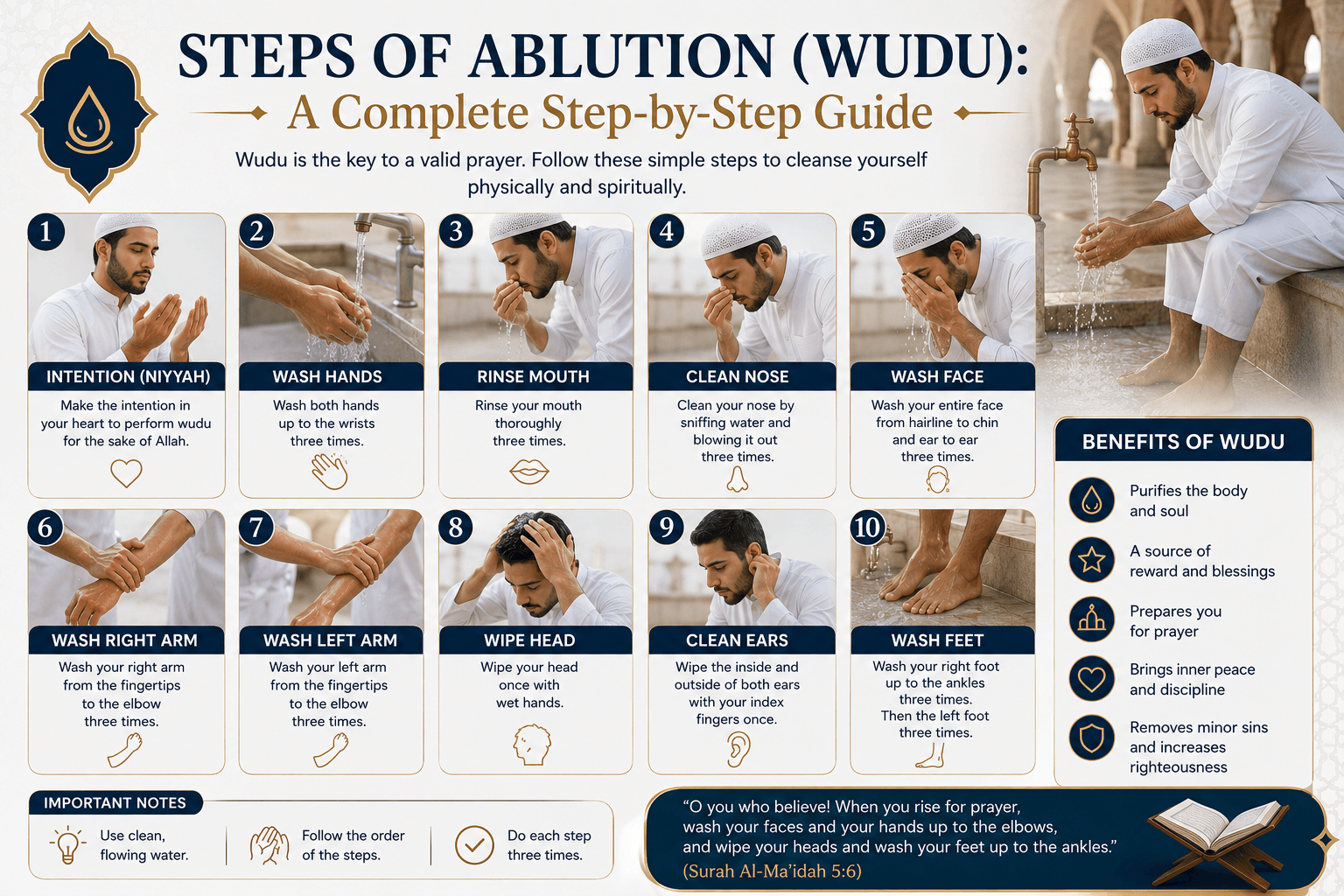
Steps of Ablution : Every prayer begins before you even raise your hands. It begins with water, intention, and a ritual that Muslims have been performing for over 1,400 years — ablution, or Wudu.
If you are new to Islam, teaching a child, or simply want to make sure you are doing it correctly, this guide walks you through every step of ablution in a clear, easy-to-follow way. No confusion, no overcomplicated language — just exactly what you need to know.
What Is Ablution (Wudu) in Islam?
Ablution — known as Wudu in Arabic — is the Islamic act of ritual purification using water. It is an obligatory condition before performing Salah (prayer), touching the Quran, and certain other acts of worship.
Allah commands it directly in the Quran:
“O you who have believed, when you rise to perform prayer, wash your faces and your hands to the elbows, and wipe over your heads and wash your feet to the ankles.” — Surah Al-Ma’idah (5:6)
The Prophet Muhammad ﷺ reinforced this clearly:
“No prayer is accepted without purification.” — Sahih Muslim
Wudu is not just physical hygiene. Scholars across all four major madhabs (schools of Islamic jurisprudence) — Hanafi, Maliki, Shafi’i, and Hanbali — describe it as a spiritual act that prepares the heart and body to stand before Allah.
What You Need Before Starting Ablution
Before going through the steps of ablution, make sure:
- Clean water is available (tap water is perfectly valid)
- You are free from major ritual impurity (janabah)
- There are no barriers on your skin — remove nail polish, thick creams, or anything that prevents water from reaching the skin
The Steps of Ablution (Wudu) — Complete Guide
Here are the full steps of Wudu, covering both the obligatory (Fard) acts and the highly recommended Sunnah acts.
Step 1: Make the Intention (Niyyah)
Before you touch the water, pause for a moment and set your intention.
Niyyah does not need to be said out loud. It is an act of the heart. You simply intend, “I am performing Wudu to purify myself for prayer.”
This silent moment is what separates a mechanical habit from an act of worship. Many people rush past this step, but it is what gives Wudu its spiritual weight.
Is Niyyah obligatory? Yes — according to the Shafi’i and Hanbali madhabs. The Hanafi madhab considers it a Sunnah, but universally it is agreed to be essential for the spiritual validity of the act.
Step 2: Say Bismillah
Begin by saying:
“Bismillah” (In the name of Allah)
The Prophet ﷺ said: “There is no Wudu for the one who does not mention the name of Allah upon it.” (Abu Dawud)
This is a Sunnah act that connects your physical action to divine consciousness from the very first moment.
Step 3: Wash Both Hands Three Times
Start with the right hand, then the left.
Wash from the fingertips to the wrists, making sure water reaches between your fingers. Do this three times for each hand.
This step physically removes dirt and also signals the beginning of the purification process. Think of it as clearing the slate before you prepare to meet Allah.
Sunnah tip: Interlace your fingers during washing to ensure water reaches every gap.
Step 4: Rinse the Mouth (Madmadah) Three Times
Take water into your mouth, swirl it around thoroughly, and spit it out. Repeat three times.
This step — called Madmadah — cleanses the inside of the mouth and is part of the prophetic Sunnah. Use your right hand to bring water to your mouth.
If you are fasting, be careful not to let water go down your throat. Rinse gently.
Step 5: Clean the Nose (Istinshaq) Three Times
Sniff water gently into your nostrils using your right hand, then blow it out using your left. Repeat three times.
This is called Istinshaq (inhaling water) and Istinthar (expelling it). It is a Sunnah act confirmed by multiple authentic hadiths and is practiced by Muslims across all schools of thought.
Step 6: Wash the Entire Face Three Times (Fard)
This is one of the four obligatory acts of Wudu.
Wash your face completely — from the hairline at the top of the forehead down to the bottom of the chin, and from one earlobe to the other. Do this three times.
Make sure water reaches:
- Under the nose
- The area around the lips
- The sides near the ears
For men with beards: If the beard is thin, water must reach the skin beneath it. If it is thick and full, passing water over the beard is sufficient, though it is Sunnah to run wet fingers through it.
Step 7: Wash the Arms Up to the Elbows Three Times (Fard)
This is the second obligatory act.
Start with the right arm — wash from the fingertips all the way up to and including the elbow. Then do the same with the left arm. Repeat three times for each arm.
Make sure the elbow is fully included. Many people stop just below it — that is a common mistake that invalidates this part of Wudu.
Step 8: Wipe Over the Head (Masah) — Once (Fard)
Wet your hands and wipe over the head once — from the front of your hairline to the back of your neck, and then back again.
This step is called Masah and it is the third obligatory act. Unlike other steps, you do not pour water over the head. You simply pass your wet hands over it.
Important: This is done only once, not three times. This is a common area of confusion.
Immediately after Masah of the head, use your index fingers to wipe the inside of your ears and your thumbs to wipe the back of the ears. This is a Sunnah act that many people skip but is highly recommended.
Step 9: Wash Both Feet Up to the Ankles Three Times (Fard)
This is the fourth and final obligatory act of Wudu.
Wash the right foot first — from the toes up to and including the ankle. Make sure water reaches between your toes. Repeat three times for each foot, then do the left.
The Prophet ﷺ specifically warned about neglecting the heels and the gaps between the toes. Do not rush through this step.
Step 10: Recite the Du’a After Wudu (Sunnah)
After completing your Wudu, raise your gaze to the sky and recite:
“Ash-hadu an la ilaha illa Allah, wahdahu la sharika lah, wa ash-hadu anna Muhammadan ‘abduhu wa rasuluh. Allahumma-j’alni min at-tawwabeen waj’alni min al-mutatahhireen.”
“I testify that there is no god but Allah alone, with no partner. And I testify that Muhammad is His servant and Messenger. O Allah, make me among those who repent and make me among those who purify themselves.”
The Prophet ﷺ said that whoever recites this after Wudu will have all eight gates of Paradise opened for them. (Sahih Muslim)
The 4 Obligatory (Fard) Acts of Wudu — Summary
If any of these are missed, the Wudu is invalid:
| # | Fard Act | Detail |
|---|---|---|
| 1 | Washing the face | Once, covering the full face |
| 2 | Washing arms to elbows | Including the elbow itself |
| 3 | Wiping over the head | At least a portion of it |
| 4 | Washing feet to ankles | Including the ankle |
Common Mistakes People Make During Ablution
Even people who have been performing Wudu for years sometimes make these errors:
- Not including the elbows when washing the arms
- Not reaching between the toes when washing the feet
- Wiping the head three times instead of once
- Forgetting the ears after Masah
- Rushing without ensuring water reaches every required area
- Not starting with the right side for hands and feet
What Breaks Wudu (Nawaaqid al-Wudu)?
Your ablution remains valid until one of the following occurs:
- Passing gas, urine, or stool
- Deep sleep (lying down or sleeping in a way that removes consciousness)
- Bleeding significantly (according to some madhabs)
- Touching private parts directly (according to some scholars)
- Loss of consciousness or fainting
Ablution for Special Situations
Wudu for women: The steps are the same for men and women. Women do not need to undo braided hair during Wudu — Masah over the head is sufficient.
Wudu over leather socks (Khuff): If you wore leather socks while in a state of Wudu, you may wipe over them instead of removing them and washing the feet — for up to 24 hours (or 72 hours when travelling).
Tayammum (Dry Ablution): When water is not available or cannot be used due to illness, Islam permits Tayammum — striking the hands on clean earth or dust and wiping the face and hands.
Spiritual Benefits of Wudu
The physical steps of ablution are only part of the picture. The Prophet ﷺ described the spiritual dimension beautifully:
“When a Muslim washes his face during Wudu, every sin he committed with his eyes is washed away. When he washes his hands, every sin his hands committed is erased. When he washes his feet, every sin toward which his feet walked is forgiven — until he emerges completely purified from his sins.” — Sahih Muslim
Wudu is a daily reset. Five times a day, a Muslim returns to a state of intentional cleanliness — physically and spiritually. It is one of the most accessible acts of worship in Islam, requiring nothing but water and a few minutes of attention.
Frequently Asked Questions (FAQs)
Q1: How many steps are in ablution (Wudu)? There are 4 obligatory (Fard) steps — washing the face, arms to elbows, wiping the head, and washing the feet to the ankles. With Sunnah acts included, the full process involves around 8 to 10 steps, starting from Niyyah and ending with the du’a after Wudu.
Q2: Can you perform Wudu without saying Bismillah? Yes, the Wudu is still technically valid without it. However, saying “Bismillah” is a confirmed Sunnah of the Prophet ﷺ, and some scholars consider it obligatory. It is best to always include it.
Q3: Do you have to wash each body part three times? The three-time washing of each body part is Sunnah, not Fard. Washing once is sufficient for the Wudu to be valid, but washing three times is more complete and earns greater reward.
Q4: Does Wudu break if you touch a woman? This is a well-known point of difference between madhabs. According to the Shafi’i madhab, direct skin contact with a person of the opposite gender (outside of close relatives) breaks Wudu. The Hanafi madhab does not consider this a nullifier unless there is desire involved. Follow the ruling of your madhab.
Q5: Is Wudu valid if water does not reach every part? No. If any of the four Fard areas — face, arms, head (Masah), or feet — are left dry, the Wudu is incomplete and invalid. This is why thoroughness matters more than speed.
Q6: Can children perform Wudu the same way as adults? Yes, the steps are the same for children. It is recommended to begin teaching children the correct steps of ablution from around age 7, as this is the age at which they are encouraged to start praying.
Q7: What is the difference between Wudu and Ghusl? Wudu is a partial ritual purification performed before prayer and involves specific body parts. Ghusl is a full-body wash required after major ritual impurity (such as after intercourse or menstruation). Both are forms of Islamic purification (Taharah), but they serve different purposes.
Final Thoughts
The steps of ablution are simple enough to learn in a single sitting, yet meaningful enough to practice for a lifetime. Every time you turn on the tap and begin your Wudu, you are following a tradition that connects you to 1.8 billion Muslims around the world — and to the Prophet ﷺ himself.
Take your time. Be thorough. And remember: Wudu is not a task to check off before prayer. It is the first act of worship itself.
Want to learn Quran recitation, Tajweed, or Islamic studies with certified teachers? Explore our online courses at QuranLinkOnline — flexible classes for kids and adults worldwide.